Why Many Apples Only Taste Their Best After Storage
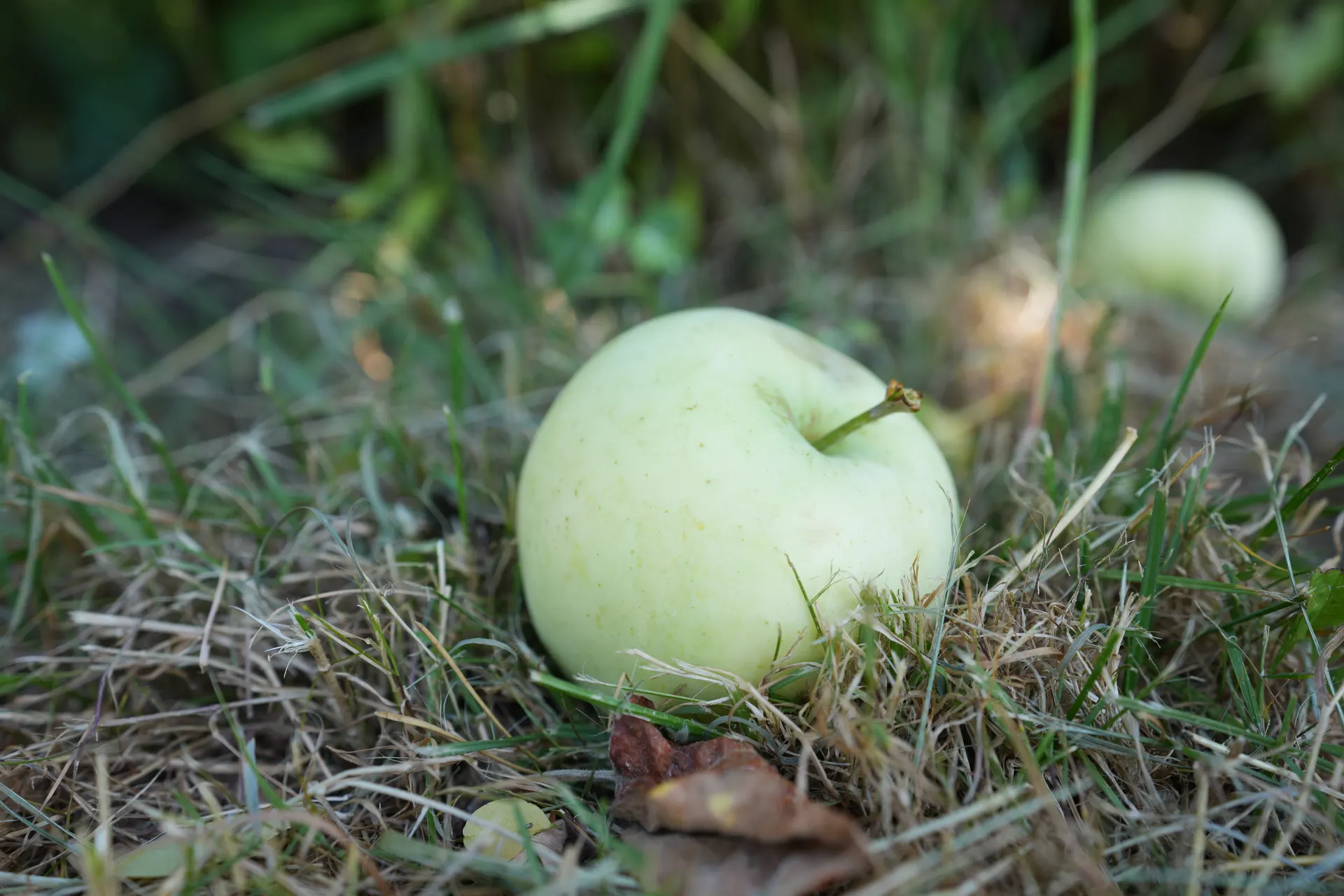
In October, windfalls lie in the grass in our garden and the last apples hang on the trees. Anyone tasting their way through the varieties soon notices that not every apple is best straight from the tree. Some varieties need a few more weeks in the cellar.
The reason lies in the fruit itself. Apples are among the fruits that keep ripening after the harvest. This is controlled by the plant hormone ethylene, which the apple produces itself. Inside the fruit, starch is gradually turned into sugar while the acidity decreases. The apple becomes sweeter and milder.
It is easy to check whether an apple is ready to pick. Lift it and twist it slightly, and it comes away from the branch by itself. The green base colour of the skin turns paler as the chlorophyll breaks down. Fruit growers also use the iodine test. They drip iodine solution onto a halved apple. Wherever starch is left, the flesh turns blue-black.
Ready to pick does not mean ready to eat, though. Early varieties such as Alkmene taste best straight from the tree and only keep for a few weeks. Late varieties such as Clivia or Schweizer Orange only develop their full flavour in storage and are best from December to March. Breuhahn even keeps until April.
For this to work, apples need cool storage at 1 to 4 degrees, with fresh air and high humidity. A cellar works well. Because apples give off ethylene, they should not be kept next to other fruit or vegetables. Bananas, kiwis or tomatoes ripen faster next to them, and potatoes sprout sooner.
Apple trees need a partner. Most varieties cannot pollinate themselves and depend on pollen from another variety. In spring, bees and bumblebees carry it from tree to tree. That is why orchards almost always have several varieties growing side by side.
This has a consequence that surprises many people. Every apple pip carries the genes of two parents: the tree itself and the variety the pollen came from. If you plant a pip, it grows into a tree with apples of its own, in other words a new variety. To keep a variety, it is grafted. A twig is cut from a tree of that variety and joined onto the trunk of a young tree, called the rootstock. The twig grows on and later bears the same apples as the tree it came from. This is how all Cox Orange trees go back to a single seedling that Richard Cox raised in England around 1830.
Several thousand apple varieties are known worldwide. Supermarkets usually sell only a few of them, the ones that travel well and keep for a long time. Many older varieties are hardly sold any more, even though they differ clearly in taste, acidity and firmness.
Some of these varieties grow in our garden. In autumn 1974, Ralf's parents planted around 180 apple trees here, including Alkmene, Auralia, Breuhahn, Clivia, Cox Orange, Erwin Baur, Gelber Köstlicher and Schweizer Orange. We still have the hand-drawn site plan from back then. Each colour on it stands for a variety, each dot for a tree.
Some of these trees still bear fruit today. Our harvest starts in mid-September with Alkmene. From the end of September, Breuhahn, Cox Orange, Schweizer Orange and Clivia follow, then Auralia and Erwin Baur in early October. Gelber Köstlicher comes last, until around 20 October.
If you stay with us in autumn, you are welcome to pick some apples. In season, breakfast also includes regional fruit. We are happy to show you the old site plan.